Practice TOEFL Listen and Repeat in 10 Minutes a Day
Learn the Listen and Repeat six techniques that actually improve memory, accuracy and fluency — in just a few focused minutes a day.
Why Listen and Repeat Is Harder Than It Looks
Listen and Repeat is the first task in the 2026 TOEFL Speaking section. At first glance, it seems simple: listen to a sentence and repeat it.
But there's a catch.
You hear the sentence only once, you never see the text while listening, and you need to start speaking almost immediately.
That makes Listen and Repeat less about "speaking freely" and more about your ability to listen, remember, and reproduce a sentence accurately.
The good news? You don't need an hour a day. With the right approach, you can practice in just a few focused minutes — which is exactly how the Listen and Repeat practice in DailyWordtoon is designed.
What Is TOEFL Listen and Repeat?
The 2026 TOEFL Speaking section has two tasks: Listen and Repeat and Take an Interview. Here is how Listen and Repeat works:
- You don't see the sentence on the screen.
- The sentence is played only once.
- There is no traditional preparation time.
- You need to start speaking right after the audio finishes.
- Sentences progress from shorter and simpler to longer and more complex.
- Your response is scored on accuracy, pronunciation, intonation, and fluency.
The most important thing to understand is this:
You are not being asked to explain the sentence. You need to repeat what you heard as accurately as possible.
So knowing the meaning of a sentence is not enough. You have to remember the actual words and reproduce them naturally.
Why Do Students Find It Difficult?
Many students are used to listening practice where they can:
listen → replay → read the transcript → listen again → repeat.
That routine is great for general English learning, but it is different from the TOEFL task.
In Listen and Repeat, everything happens after one listen:
hear the sentence → hold it in short-term memory → remember the structure → reproduce the words → keep natural pronunciation and intonation.
That's why doing more shadowing practice alone is not necessarily enough. You need to train the specific skill of remembering a sentence after hearing it once.
The Best Way to Practice
A good practice session doesn't need to be long. Instead of rushing through a large number of questions, focus on the quality of each attempt.
The basic routine is simple:
Listen once → Repeat → Review → Find the problem → Try again
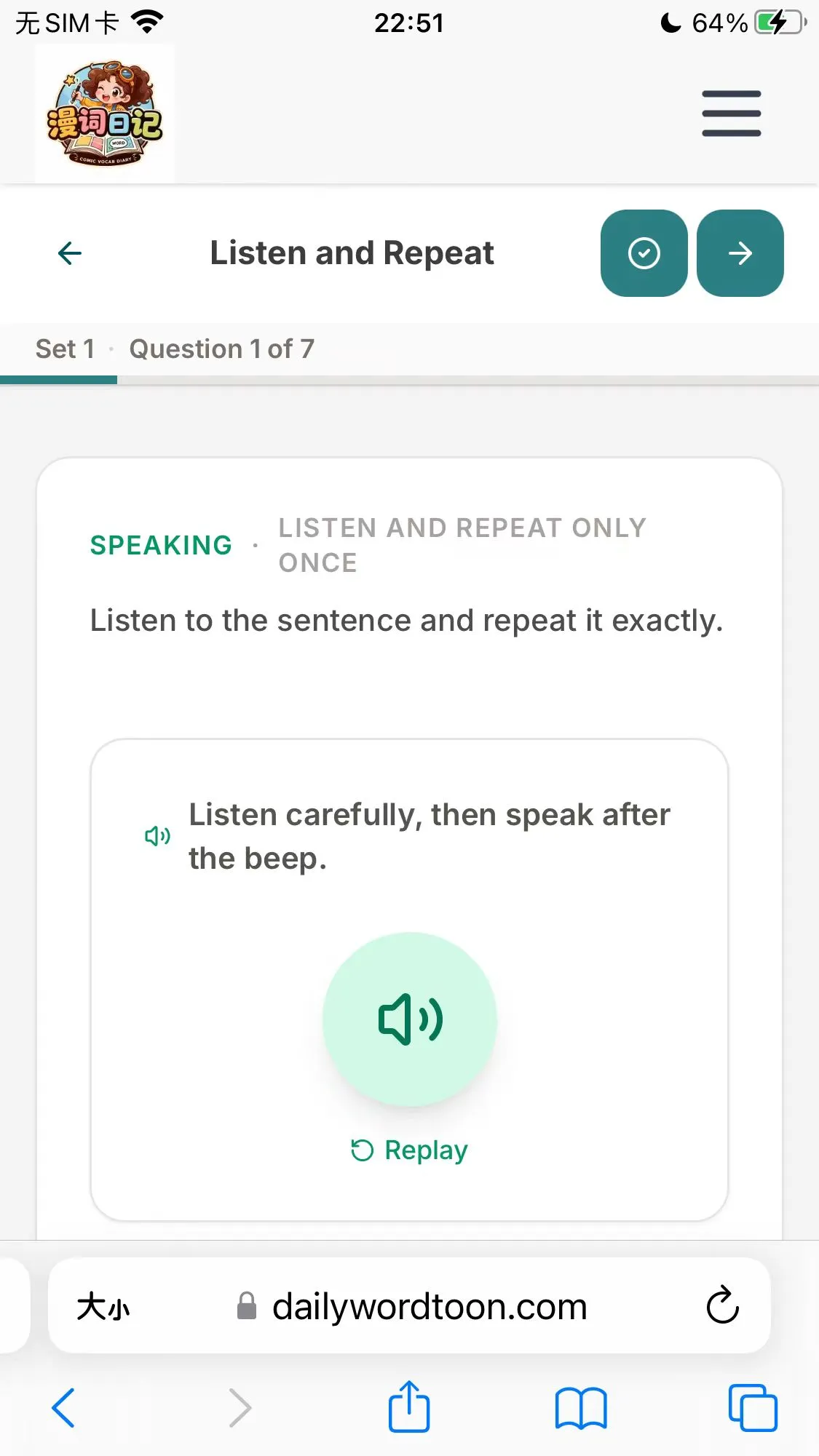
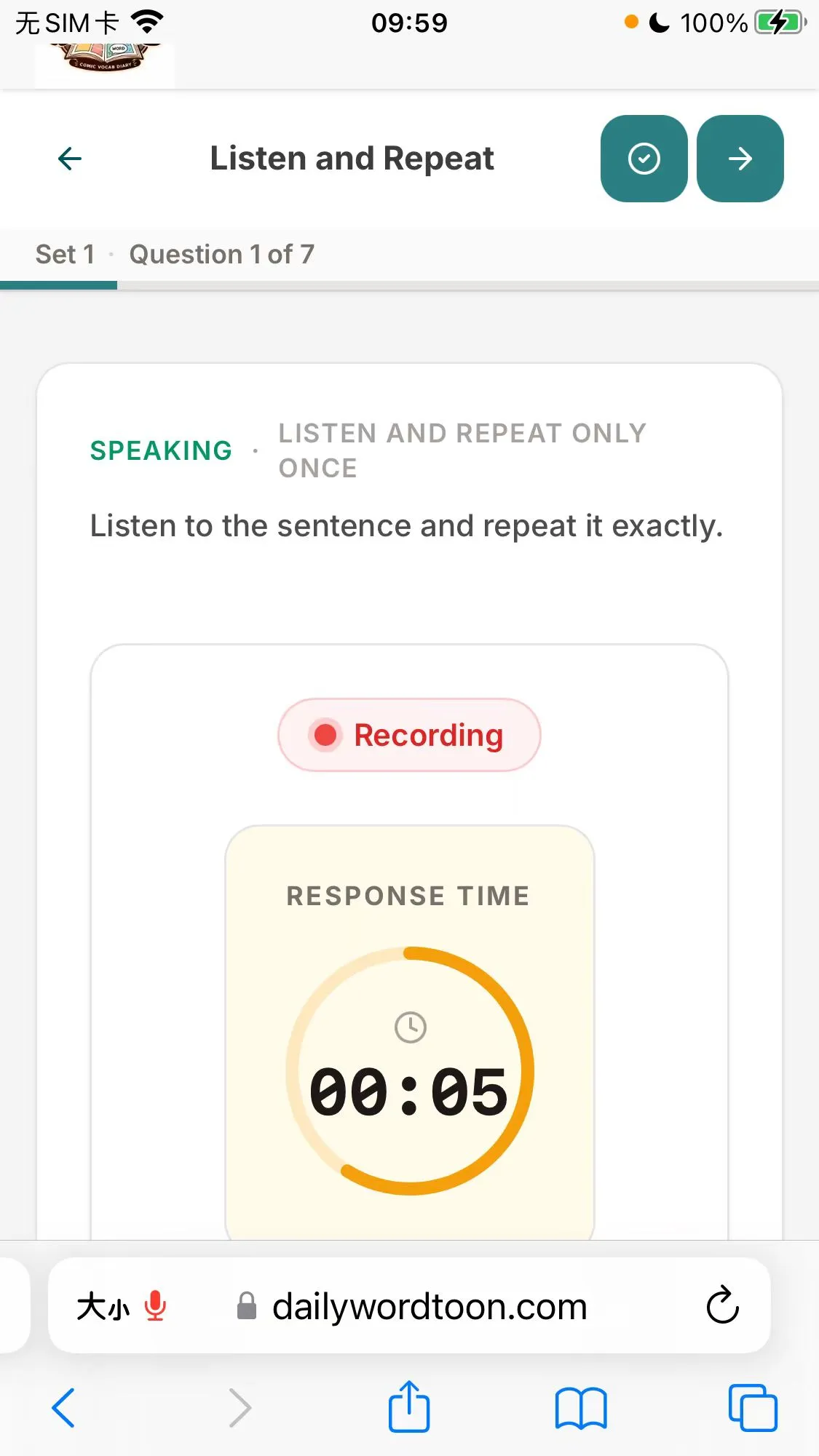
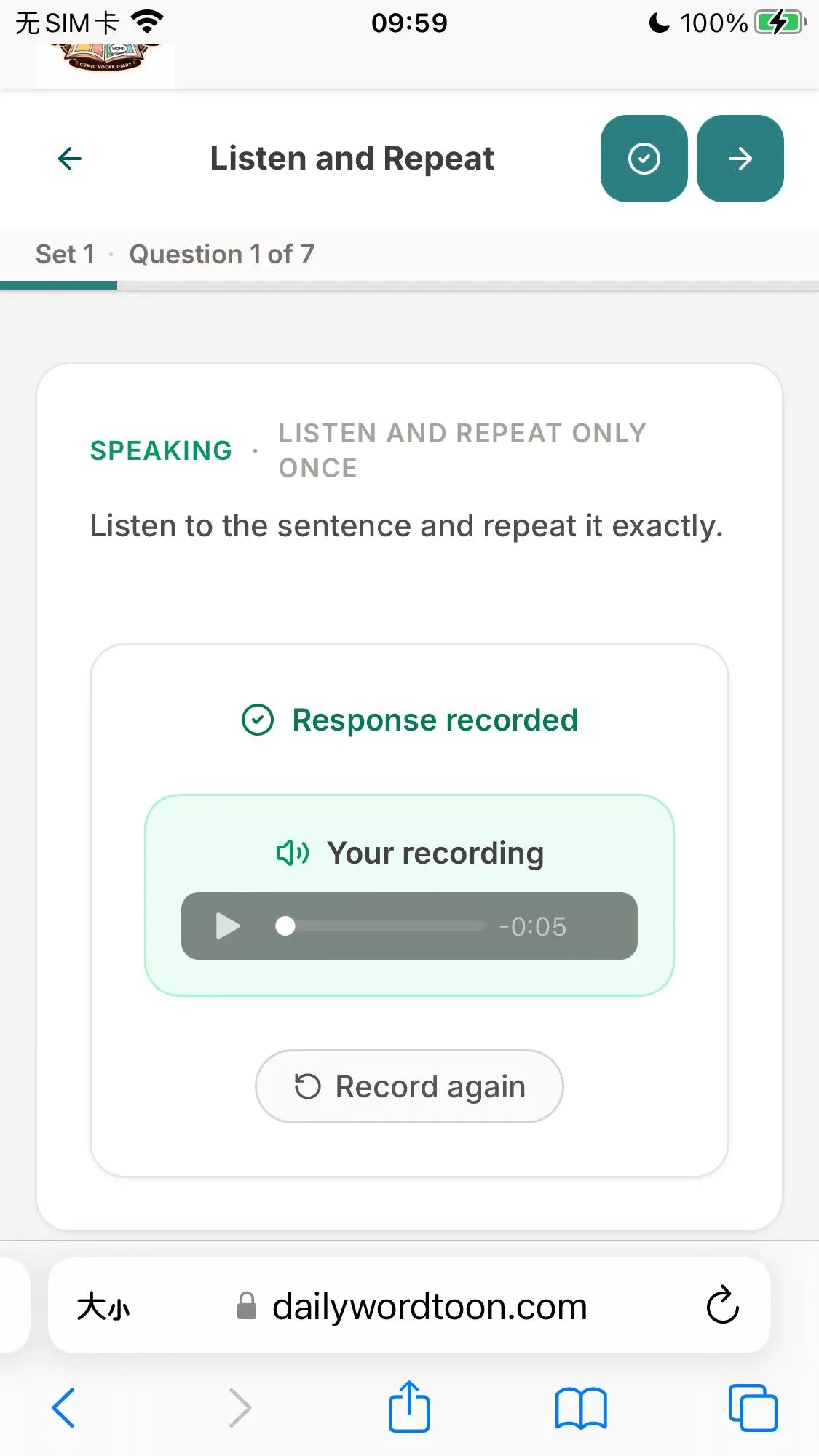
This is the approach you can use with DailyWordtoon. In Targeted Practice, open Speaking → Listen and Repeat and go through the six steps below.
1. Listen Only Once
This is the most important rule. Don't immediately replay the audio because you missed a word — the test won't give you a second chance.
If you always practice with unlimited replays, you may get very good at repeating sentences you've already heard several times, but you won't be comfortable hearing a brand-new sentence only once.
For your first attempt, treat the exercise like a mini test:
- Listen once.
- Immediately repeat the sentence.
- Don't worry about getting everything perfect.
The goal of the first attempt is to see what you can remember naturally.
2. Remember Meaningful Chunks, Not Individual Words
Trying to memorize a long sentence word by word overloads your memory. Instead, divide the sentence into meaningful groups:
Please return your tray / to the window on your left / before leaving.
You don't need to consciously memorize every word separately. Your brain can hold the sentence as several connected chunks — which matters more and more as sentences get longer.
During review, ask yourself: where did my memory break down? Maybe you remembered the first chunk but forgot the middle, or kept the main idea but lost the final phrase. Don't just mark the item "wrong" — identify the missing chunk and practice that part again.
3. Remember the Sentence Structure
Another useful technique is to identify the basic structure first:
The professor / will discuss / the new research project / after class.
Remember Who → does what, then attach the additional information. This gives your memory a framework to work with.
When sentences get longer, recalling every word independently becomes increasingly difficult — a structure gives your brain an anchor. During review, look at difficult sentences and identify their structure, then repeat them again without reading aloud first.
The goal isn't to memorize the sentence permanently. It's to train your brain to rebuild a sentence quickly after hearing it.
4. Pay Attention to Intonation and Rhythm
Listen and Repeat isn't only about getting the words right — your response should also sound natural.
Pay attention to:
- sentence stress
- rising and falling intonation
- natural pauses
- connected speech
- speaking rhythm
Don't turn a sentence into a sequence of isolated words. Try to reproduce the rhythm of the original speaker.
The review stage is your chance: listen to the original again and focus on stress → rhythm → intonation → linking, then repeat once more.
This creates an important distinction:
- First attempt: test your memory.
- Review: improve pronunciation and delivery.
5. Don't Stop Because of One Missing Word
What happens when you suddenly forget a word? Don't freeze. A long pause can make it harder to finish the sentence naturally.
Keep going with what you remember and try to complete the sentence, then review the recording afterward.
Often your biggest problem isn't pronunciation at all. Many students consistently forget:
- the beginning of sentences
- numbers
- names
- prepositions
- the second half of long sentences
Finding that pattern is far more useful than completing more random questions.
6. Gradually Increase the Difficulty
Don't start by forcing yourself to repeat the longest sentences. Build the skill in stages:
Level 1: Short sentences
Focus on Listen once → Repeat accurately until the one-listen condition feels comfortable.
Level 2: Longer sentences
Move to longer sentences and more complex structures, adding chunking + sentence structure + memory to the practice.
Level 3: Test-like practice
Finally, practice under realistic conditions: one listen → short response window → immediate speaking. This is when your practice starts to feel like the real test.
A 10-Minute Daily Routine
One reason students struggle to prepare for TOEFL is the feeling that they need a large block of free time. For Listen and Repeat, you don't.
A 5–10 minute focused session is enough. For example:
Minutes 1–5: Complete a short Listen and Repeat set.
Minutes 5–7: Review the sentences you missed.
Minutes 7–9: Identify your main problem — memory, missing words, pronunciation, intonation, or fluency.
Minutes 9–10: Repeat the most difficult sentences again.
That's a complete practice session. You can fit it in while commuting, between classes, or before bed.
Don't Just Count Questions — Track Your Mistakes
Doing 50 questions doesn't automatically mean you've improved. A better question is: what did I learn from those 50 questions?
After each session, look for recurring patterns:
"I often forget the last part of long sentences."
Then your next session has a clear purpose: practice longer sentences, chunking, remembering sentence endings, and keeping fluency while speaking.
This turns practice into a cycle:
Practice → Review → Find your weak point → Practice again
That's much more useful than simply increasing the number of questions you complete.
Final Takeaway
TOEFL Listen and Repeat is not ordinary shadowing. You aren't only practicing pronunciation — you're training several skills at the same time:
one-time listening + short-term memory + accurate repetition + pronunciation + intonation + fluency.
So your practice should reflect the real task. Instead of replaying the same sentence until it's perfect, challenge yourself to remember it after hearing it once.
With DailyWordtoon, you can turn this into a simple daily routine: Practice → Review → Find your weak point → Practice again. Even a few focused minutes on your commute can become genuinely useful TOEFL practice.
Listen once. Repeat. Review. Improve.
Start practicing TOEFL Listen and Repeat with DailyWordtoon →