How to Practice TOEFL Complete the Words Task
A step-by-step method to master the 2026 TOEFL Reading "Complete the Words" task and practice with a 10–15 minute daily plan.
In the updated TOEFL iBT (from 2026), the Reading section includes a new task called Complete the Words. You will see a short academic paragraph of about 70–100 words. The first sentence is complete, but starting from the second sentence, the second half of certain words is removed. Your job is to fill in the missing letters based on context and the letters that remain. Each paragraph usually contains 10 blanks, and spelling must be 100% correct to earn the point.
Here is a clear, step-by-step practice method you can follow.
Step 1: Fully Understand the Task Format
Before practicing, make sure you know exactly how the question works:
- The first sentence is always fully intact (this is your most important clue).
- From the second sentence onward, parts of words are deleted.
- You must use context + visible letters + grammar to complete each word.
- There is no partial credit — one wrong letter means zero points for that blank.
Practice tip: Look at 2–3 real or high-quality practice paragraphs first without filling anything in. Just observe the pattern and how the first sentence helps.
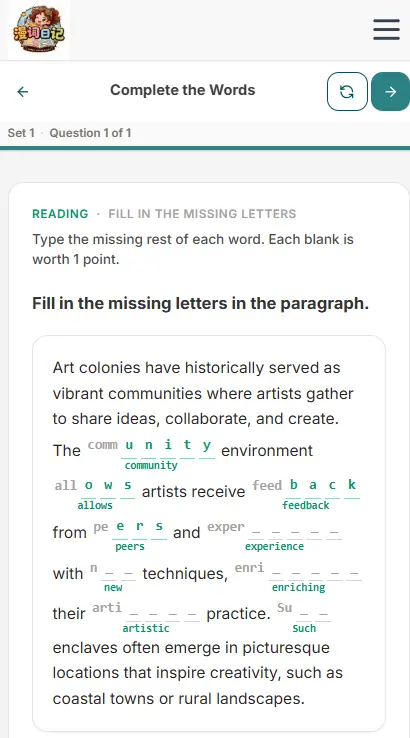
Step 2: Build the Habit of Reading the Whole Paragraph First
Golden rule: Always read the entire paragraph before filling in any blanks.
Recommended process:
- Spend 15–20 seconds reading the whole paragraph quickly to grasp the topic, tense, and logical flow.
- On the first pass, only fill in the easy blanks (function words, fixed collocations, obvious endings).
- On the second pass, return to the harder blanks with better context.
This approach significantly reduces random guessing.
Step 3: Use the “Part of Speech + Letters + Context” Method
For every blank, follow this order:
- Decide what part of speech is needed (noun, verb, adjective, adverb?).
- Combine it with the visible letters to narrow down possibilities.
- Put the completed word back into the sentence and check whether both the meaning and grammar make sense.
Pay special attention to:
- Singular/plural forms (-s / -es)
- Verb tense and aspect (-ed / -ing)
- Word-form changes (-tion / -al / -ly)
Learn more about word formation.
Step 4: Target Common Weak Points
Focus your practice on these three areas:
- Accurate spelling of academic vocabulary (e.g., environment, analysis, significant, research)
- Function words and transition words (however, although, therefore, despite)
- Correct word forms of the same word family
Suggested drill: Every day, take 10–15 high-frequency academic words, cover the second half, and practice completing them from memory.
Step 5: Timed Practice + Error Review
- Target time: 60–90 seconds per paragraph (10 blanks)
- Do at least 3–5 full practice paragraphs every week under timed conditions
- Keep an error log: Record words you misspelled, chose the wrong form for, or misunderstood, then review them regularly
Recommended Daily Practice Plan (30 minutes)
| Time | Activity |
|---|---|
| 5 min | Review your error log |
| 15 min | Complete 2–3 Complete the Words paragraphs (timed) |
| 10 min | Check answers and analyze mistakes |
If you stick to this routine for 2–3 weeks, both your accuracy and speed will improve noticeably.